
How to Price No-Code Proposals (From Both Sides of the Table)
Same project. Proposals from $20K to $300K. The gap comes down to process clarity, scale, risk, stack transparency, time horizon, and ROI. How to read no-code proposals before you sign.
Most clients start with the wrong question.
"Can you give me a fixed price?"
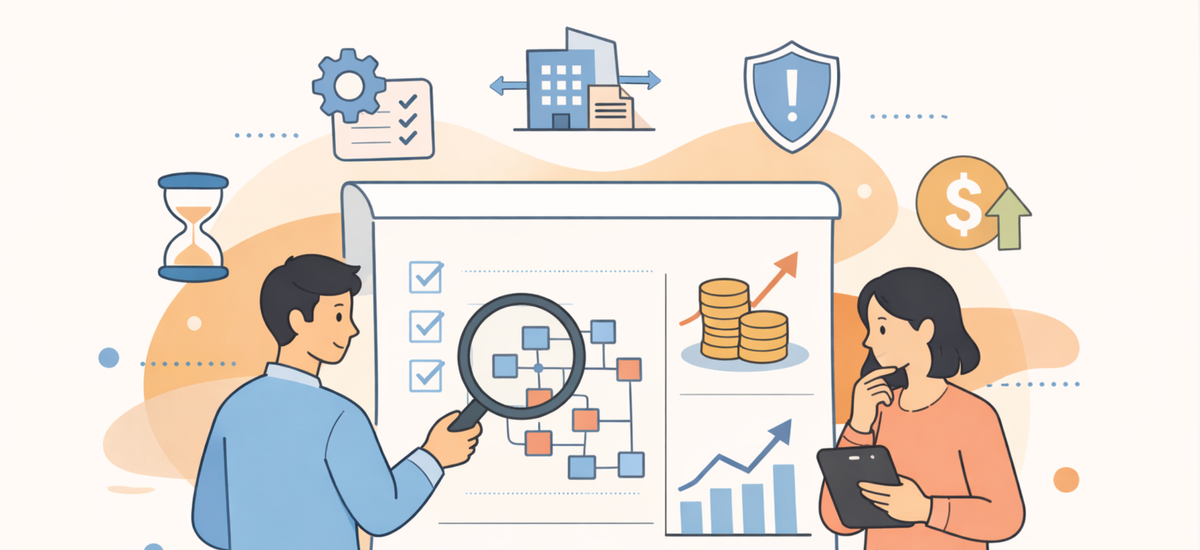
That's not where pricing begins. Before a number means anything, you need clarity on six things: process maturity, scale expectations, risk allocation, technical depth, time horizon, and ROI.
We recently saw an AI project where the client told us the proposals they received ranged from $20,000 to $300,000. Same project. Same requirements document. Ten different vendors, 10 completely different stories.
That spread isn't unusual. And it isn't random.
The gap exists because vendors are pricing different things. Some are pricing features. Others are pricing failure prevention. Most clients can't tell the difference until month four, when the build starts breaking.
Here's how to read a proposal before you sign one.
1. Do You Even Know Your Process?
If you can't describe your workflow step by step, you don't need proposals. You need discovery.
Ask yourself:
- Can you walk someone through the process from trigger to outcome?
- Do you know who touches the data at each step?
- Do you know the edge cases?
- Is your current system failing, or just annoying?
If your processes are unclear, pricing is fiction. Vendors will either underbid and issue change requests later, overbid to protect themselves, or build something that doesn't solve the root problem. And you'll have no way to tell one from the other.
This is something we see constantly. Half the clients who come to us haven't done any process mapping. They know how work flows across the org, but not much about how it should flow and through what tools. That gap is where bad proposals come from, on both sides.
Eric, from a consulting firm we built an applicant tracking system for, put it this way: "The single fact that you viewed your process entirely from end to end and restructured it... that would give more gains than just implementing AI in the system."
That's not a technology insight. That's a process insight. And it came from a six-month engagement that started with mapping, not building.
When we work with clients, the entry point is a Blueprint session. Four to eight hours of story mapping and process analysis. Before any building starts. Because building is 30% of the job. Requirements gathering, process mapping, tool selection, UI design, Testing, stakeholder alignment -> that's the other 70%.
If a vendor skips that phase, they're guessing. And you're paying for the guess.
A study by the Standish Group found that only 29% of software projects succeed on time and on budget. The primary driver of failure isn't technology. It's unclear requirements and poor stakeholder alignment (standishgroup.com). No-code projects aren't immune to this. The tooling is simpler, but the scoping problem is identical.
2. Think About Scale (Be Honest)
Here's something most no-code vendors won't tell you:
No-code systems scale well until they don't.
| System Type | Expected Scaling | Notes |
|---|---|---|
| Custom code (well-built) | 10x-50x | Requires architecture planning, experienced team |
| No-code (Airtable, Softr, Make, etc.) | 2x-5x comfortably | Hits limits on record counts, API volume, complex logic |
| Scrappy glue automation | 1x-2x | Breaks under any structural change |
Airtable's Business plan caps at 500,000 records per base and 6 API calls per second. Those numbers sound large until you're running a multi-department system with automations firing on every record change. We've written before about building automation systems that don't break at 2 AM and the scaling question is directly connected to that.
If you're planning 2x growth in 2 years, no-code is a strong fit. If you're planning 20x growth with deep customization, budget for hybrid or custom architecture.
A recent case study from Enraged Camel, a two-person startup, showed them using Claude Opus 4.5 to re-architect their multi-tenancy layer in 2.5 weeks, a project they estimated would have cost six figures and four to six months with traditional development (enragedcamel.dev). That's real. But notice the context: the founder had 10+ years of development experience and reviewed every line of code. AI reduced the build time. It did not remove the need for architectural judgment.
A $10K Airtable system isn't meant to power a $200M enterprise in five years. And that's fine. It's meant to get a $3M company to $6M without spending enterprise money along the way. That's the practical approach.
3. Risk: Who's Carrying It?
This is where quotes diverge most.
When ten vendors give you a spread from $20K to $300K, the price difference isn't primarily about skill or tools. It's about risk allocation.
Higher quotes typically:
- Include discovery and process mapping
- Include iteration cycles and client review
- Include documentation
- Include scalability planning
- Carry architectural risk on the vendor side
Lower quotes typically:
- Build only what's explicitly written in the brief
- Push ambiguity back to the client
- Minimize scope
- Avoid edge cases
- Price features, not outcomes
Every project pays the full cost eventually. The only variable is when.
Cheap quotes transfer risk to you. Expensive quotes absorb more ambiguity. There's no universally right answer, but you need to know what you're buying.
Here's one way to test it: ask the vendor, "Can I hold you to that number?"
The cheap agency will almost always say no. They know the project will balloon. The vendor who spent real time scoping will tell you the boundaries: what's included, what triggers a change order, and what happens if they go over.
The documentation gap is part of this. Cheaper engagements rarely produce system documentation. That means every future change, whether handled by you, the original vendor, or a new one, requires reverse-engineering the system first. That cost gets paid eventually. It just doesn't show up in the proposal.
When we scope projects, we use sprint-based delivery. Two-week sprints, fixed sprint price, scope locked per sprint. Reassessed continuously. You never truly know the total cost until you're close to done. Anyone claiming otherwise is either guessing or padding.
4. Technical Stack: Is It Understandable to You?
This matters more than people think.
An Airtable base paired with a Zite portal is visible and inspectable. You can open it. You can understand the fields. You can modify workflows. You can hire someone else later.
A vibe-coded backend or an opaque Postgres admin portal? You're dependent on the original developer. Permanently.
This is the build vs. rent question applied to your own system. If the vendor builds something only they can maintain, you haven't bought a system. You've bought a subscription to that vendor.
The stack also changes the pace and shape of delivery. Someone building on Airtable will ship a working interface faster than someone building on Supabase, but the Supabase build may handle more complex queries and larger datasets long-term. Someone using Monday will have different constraints and a different delivery speed than someone using Bubble. The tool isn't just a technical choice. It sets the ceiling on what can be built, how fast, and at what cost.
This means two proposals using different stacks aren't directly comparable even if the deliverable sounds the same. A "client portal" built in Softr takes a different number of hours, has different scaling limits, and carries different ongoing costs than the same portal built in Retool or a custom React app. When you're comparing quotes, compare the stack assumptions, not just the final number.
When we built Jemini's ATS, the architecture was deliberate. Three to five paid Airtable editors. Everyone else on free Zite interfaces. The twentieth interviewer costs the same as the third. Fillout for forms. n8n self-hosted on Elest.io for automations.
Dan, who runs recruitment at Jemini, called the shortlisting tool "a playground." No commercial ATS had an equivalent. But it's built on tools the team can see and touch. That was a design choice, not a limitation.
When pricing a proposal, ask yourself:
- Do I want transparency and the ability to modify later?
- Or do I want maximum performance and accept vendor dependency?
- What happens to this system if the vendor disappears?
- What are the ongoing platform costs of this stack at my expected scale?
5. The Vendor's Approach Matters More Than Their Tools
Two vendors can use the exact same stack and deliver completely different outcomes. The difference is rarely the tools. It's how the person behind them thinks about your problem.
Someone using Claude Code or Cursor will write code faster than someone who isn't. That's real. But someone who doesn't know how to code will deliver a poorer product than someone who does, regardless of how good the AI assistant is. The tool accelerates the person. It doesn't replace what the person knows.
This is true across the spectrum. AI made demos cheap. It did not make production systems cheap. A vendor who can spin up a working prototype in two days using AI-assisted coding may still not understand your data model, your edge cases, or why your team rejected the last three tools they were given.
On the other end, someone who is great at mapping processes and selecting the right tools will often deliver a better outcome even without writing a single line of code. Because they understand the deliverables and constraints before they start building. They know what "done" looks like to the five people who have to use the system every day. The original request is never the real problem. "We need a new CRM" usually means something else entirely. Takes two or three conversations to find it.
The approach question breaks down into a few things worth asking:
How does the vendor handle discovery?
Do they ask about your workflows before proposing a solution? Or do they jump straight to a tool recommendation? A vendor who leads with "we'll build this in Bubble" before understanding your process is optimizing for their comfort, not your outcome.
What's their background?
A developer who picked up no-code will approach problems differently than an operations person who learned to build systems. Neither is inherently better. But the developer will tend toward technical elegance while the ops person will tend toward adoption and fit. Know which one your project needs.
How do they handle what they don't know?
The more I do this, the less certain I am about anything. Except that "why?" is still the most useful question. A vendor who has clear answers for everything on the first call either has deep experience with your exact problem, or they're not listening closely enough. Both are possible. One is more common.
Are they building for the demo or for day 40?
Day one demos are easy. Day 40 is when the sales team has entered 300 records with inconsistent formatting, the CEO wants a report that wasn't in the original scope, and someone found an edge case that breaks the automation. Ask the vendor what happens then. The answer tells you more than the proposal does.
Pricing reflects approach. A vendor who spends 15 hours on discovery before building will quote higher upfront but deliver fewer surprises. A vendor who starts building on day one will quote lower but leave the discovery cost for you to absorb later, usually in the form of change requests, rework, or a system that technically works but nobody uses.
6. What's the Timespan: 2 Years or 5 Years?
Pricing depends on time horizon.
Short-term optimization (2 years):
- Move fast
- Reduce friction
- Automate obvious waste
- Accept some technical debt
- Leverage 3rd party tools to save time
- Validate before investing heavily
Long-term infrastructure (5+ years):
- Data modeling rigor
- Migration planning
- API-first architecture
- Vendor independence, self host, reduce 3rd party tools
- Monitoring and observability
The longer the horizon, the higher the upfront design cost should be.
Most of our clients are in the two-year camp. They're companies between $2M and $10M that are running on spreadsheets and manual processes. They don't need a five-year platform. They need the next system, the one that gets them from here to there without costing enterprise money.
A Gartner survey found that 70% of new applications will use no-code or low-code by 2025, up from under 25% in 2020 (gartner.com). That projection is playing out. But "adoption" doesn't mean "permanent infrastructure." For many businesses, no-code is the bridge, not the destination.
That's a different conversation than building production infrastructure for 100,000 users.
An honest vendor will tell you where your project sits and why.
7. ROI: Price Based on Value, Not Effort
This is the uncomfortable part.
If a system will:
- Increase revenue by 30%
- Reduce labor by 400 hours a month
- Enable 2x client capacity without adding headcount
Then pricing it at $3K because "it's just Airtable" makes no sense. Sure, it is Airtable, but you need to look deeper into what the $3k is leaving on the table.
If expected annual gain = $100K, a vendor price of $10K-$20K is rational. If expected gain = $500K, a $50K build is still a strong return.
The flip side also applies. If the upside is modest, keep the budget lean. Not every process needs a $40K system. Some need a $2K automation and a cleaned-up spreadsheet.
We've written about how to calculate the real ROI of no-code projects in more detail, but the core idea is this: price based on what the project is worth to your business, not based on how long it takes to build or what tools the vendor uses.
When we built Jemini's ATS, we weren't trying to audit their software spend. We were building a recruiting system. But somewhere around month three, we started noticing what else was going on with their stack.
$20K+ in annual SaaS waste surfaced as a side effect. A $89/month Fillout Business plan got replaced with a CNAME and tny.cc for $5/month. A $1,200/month Notion bill got flagged for replacement. Calendly got replaced with Fillout Pro at $19/month for unlimited users. We wrote the full breakdown in The SaaS Tax: Finding the $20,000 You're Wasting on Tools.
None of that was in the original scope. It showed up because when you redesign how work flows through an organization, the redundancies surface on their own.
The Real Pricing Formula
Instead of asking "How much does this cost?", ask:
- How clear is my process?
- How much growth am I targeting?
- Who is absorbing discovery risk?
- How transparent and extensible is the stack?
- How is the project to be approached?
- What's my time horizon?
- What is the economic upside?
Then price accordingly.
The $20K quote and the $280K quote aren't necessarily wrong. They're pricing different things for different futures. Your job as a client is to know which future you're buying.
And if you can't answer that yet, you don't need a proposal. You need a Blueprint.
A Practical Structure
Instead of a fixed price for the whole project:
Phase 1 -> Blueprint
- Map the system
- Identify risks and edge cases
- Estimate growth stress points
- Define a sprint roadmap
Phase 2 -> Sprint-Based Delivery
- Two-week sprints
- Fixed sprint price
- Scope locked per sprint
- Reassess after each cycle
This structure keeps both sides honest. The client isn't locked into a number based on guesswork. The vendor isn't absorbing unlimited scope for a fixed fee.
Dan at Jemini said it best: "No plan survives contact with reality intact."
Build accordingly.
Oh, and DO NOT FORGET to price in the time for data migration, user feedback and most importantly, documentation.
If your processes aren't mapped and you're not sure what system you need, that's where we start. OpsTwo runs Blueprint sessions -> four to eight hours of story mapping and process analysis before any building begins. Book a Blueprint.